

Bundle of Holding: Land of Eem
Apr. 20th, 2026 02:11 pm![[personal profile]](https://www.dreamwidth.org/img/silk/identity/user.png) james_davis_nicoll
james_davis_nicoll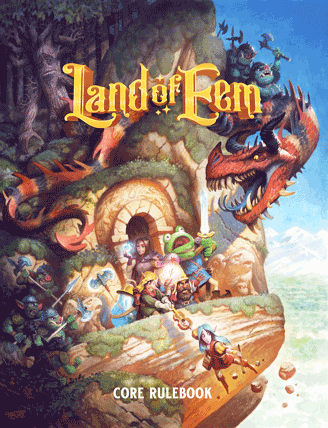
A bundle for Land of Eem, the whimsical tabletop fantasy roleplaying game of colourful characters exploring the Mucklands from Star & Flame Games and Exalted Funeral.
Bundle of Holding: Land of Eem
As always, this is about discovering something and thinking it's NEW!!!
Apr. 20th, 2026 06:00 pmoursinI will slightly concede that maybe women have not had quite the opportunities in film and TV that they have had for centuries in written fiction, though even so I suspect with a little thought we could come up with instances where female gaze was significant in creating popularity even if it hadn't been part of the purpose in making.
But as ever, the instances about fiction are limited in their genre range (OMG there is a long history of ROMANCE) and appear never to have read anything that was not on the radar approximately five minutes ago.
E.g.
[T]he genre has altered the way female worlds are received. “I wasn’t the only one who thought that if you were female in the fantasy world it wasn’t going to end well: if you fall in love it’s going to be used against you, if you have any sort of power you’re going to die or become the mad queen,” she says. “You never really saw female characters represented in any way where you felt safe, thinking they’re going to be here in the end and not have to give up their sense of identity to do so. People, almost, have been waiting for these books to come.”
Good grief.
Okay, will concede that I am currently reading The Books of Earthsea and I occasionally look up from Ursula Le Guin's commentaries and thinking a very strong case can be made that she had never, at least when she was writing those works, encountered anything by Naomi Mitchison. Which would blow out of the water certain of her contentions about female protagonising....
But leaving my much-neglected and overlooked precious aside, I scan my shelves for the works I was scooping up during the 70s-80s-90s, ahem.
And no mention of fanfic.... dearie me. Did not do the research?
***
On another topic, there was an interview with Will Self in The Observer which is paywalled, so not linking. But in it he moans that after his divorce and ex-wife claiming mental abuse, ALL their friends cut him off, even his oldest besties: which makes me rather wonder whether a) they had actually observed things going on or b) they were fed up with him whingeing on about it.
2026 Aurora Award ballot announcement
Apr. 20th, 2026 12:11 pmjames_davis_nicoll
Congratulations to the finalists!
2026 Aurora Award ballot announcement
The nominees are ( Read more... )
Krackle’s Last Movie by Chelsea Sutton
Apr. 20th, 2026 11:59 am![[syndicated profile]](https://www.dreamwidth.org/img/silk/identity/feed.png) strangehorizons_feed
strangehorizons_feed Chelsea Sutton’s debut novella, Krackle’s Last Movie, begins soon after the disappearance of the titular character. Minerva Krackle, a documentary filmmaker on a mission, wanted to show the world the real face of those affected by the CMS (Curious Monster Syndrome), a mysterious event which caused an “evolution or growth or degeneration” that left some people forever changed (p. 25). Following Krackle’s disappearance, her assistant, Harper, scrambles through recorded interviews and notes that her boss and mentor left behind, attempting to finish the film in time for a festival submission. Dipped in glittery melancholy, incisive, and indulgent in its aesthetic, this novella is an accomplished debut which interrogates the experience of being marginalized and stereotyped.
As Harper tries to tie up loose ends, she grapples with the implications of the recordings, re-watching and sometimes re-living her encounters with eccentric subjects the world deems monstrous: joyful yet sharp-humoured mermaids, a desert-dwelling sea creature, a grieving werewolf, an invisible dancer. Harper sees herself as a witness, a reluctant interviewer, and as one of the outcasts. She hides her dwarfed wings under baggy shirts, and struggles to come to terms with her own story. When curating the material and deciding what to cut and what to keep, she weighs the importance of her self-perception against Krackle’s legacy—striving to stay faithful to her mentor’s original vision while relating to, admiring, and recoiling from the interviewees who mirror her own difference.
Sutton engages in an ambitious reflection on monsters and their symbolism, giving each CMS-affected character a layered metaphorical meaning. She uses fiction to analyse monstrosity as a concept, referencing its various representations—from schlocky films to classics—and questioning the “othering” involved in its construction. In cultural criticism, monsters are “harbingers of category crisis,” figures that exist in between states: neither dead nor alive, human nor animal. [1] They are hybrids whose propensity to resist classification unsettles individuals and societies even more than their presumed capacity for violence. In the novella, “monstrosity” serves as shorthand for any existence that doesn’t align with social norms and expectations.
Sutton’s broad and inclusive definition of difference encompasses not only race, sexuality, and illness, but also loss, or even random events and accidents that set the characters apart—suggesting both the universality of the experience, and the oppressiveness of the categories they straddle. For example, upon hearing Harper describe her wings as “not natural” Krackle asks her what “natural” means. Harper replies, “you know, normal”—and, when asked what normal means, she adds “the thing that keeps you invisible” (p. 52). Sutton shows the psychological cost of suppressing all that makes us “visible.” As Harper describes it: “It’s like we hold our breaths until our lives are over” (p. 25).
The novella posits each “monstrous” character as a voice and a face of various responses to difference. Most characters share the weary I’ve-seen-it-all attitude of those who naturally inhabit a life that seems alien to others. When Harper asks the mermaids if their culinary preference for fish makes them cannibals, they counter by asking if she considers herself a monkey (p. 12). The mermaids are accustomed to being exotified, met with a mix of repulsion and fascination that marks them as special, however mundane they might appear to themselves. This constant negotiation with the judgement of others produces a hard-won resilience, making some of Sutton’s “monsters” appear heroic—capable of sharp insights, but also of compassion and understanding rarely afforded to them. When the (second) Great Merlan, a magician celebrated for her extraordinary abilities, tells her audience, “You have been amazing. Remember that,” the statement is not a platitude. It emphasises that being “othered” means needing to defend and treasure one’s beauty, knowing the high stakes of self-condemnation. She captures the fleeting moment when difference holds value and dazzles, instead of hurting, and poses the questions: When is something “special” treated as a talent and admired, and when is it considered an aberration and abhorred? Is it a matter of framing, social attitudes, context, self-presentation? It’s difficult to tell, but Sutton persists in asking.
In another scene, the interpretation of an invisible dancer’s performance depends on whether it is perceived from an internal or external perspective. What makes Isabel special on a superficial level (her invisibility) renders what really makes her special (her talent) invisible. Her vision splits in two: what she sees (the craft she worked on and developed), and what’s being perceived by others (her difference). Yet she manages to unite both in a dance so beautiful that it renders Krackle speechless. There’s something profound about Isabel then asking, “You get it?” (p. 55). Sutton, however, refuses to settle on a single perspective. She also represents those who exploit their difference, selling it for other people’s entertainment. The novella considers the role of fetishisation, with some finding the monstrous irresistible, arousing—enthralled by the oddity, their response becomes reductive to the point of total objectification. Sutton’s approach remains morally ambiguous—never didactic, always prodding. Her metaphors juxtapose surface aesthetics with psychological depth and encourage multiple readings. Each moment asks to be dissected. Each scene invites attentive deliberation that mirrors the novella’s wider concern with complexity of judgement and perception.
The novella is at its most harrowing when it focuses on the pathologisation of “otherness.” Sutton traces the institutional frameworks through which difference is managed and punished: medicalisation, which seeks to “cure” it, and religion, which tries either to exorcise or reframe it as meaningful within its own ideology. These discourses intersect with older ideas of social impurity, by which outsiders are treated as human-shaped contaminations to be contained, expelled, and morally condemned. The logic dates back to early Christianity, which treated illnesses as God’s punishment for sin, and evolved into multiple overlapping justifications that enabled violence while presenting it as care, necessity, or moral duty. Harper, whose childhood reproduces this dynamic, internalizes the bigotry of her parents, and disfigures herself to hide—literally cutting her wings as they once did, and “disposing” of herself (p. 34). Even when let go, her wings grow back warped and distorted, exemplifying development stunted by abuse.
The story of Meggie, whose transformation into a modern-day mummy functions as a metaphor for cancer, is in dialogue with Harper’s. Meggie’s relationship with her sister Liz explores the devaluation of those perceived as already lost. Harper blames Liz for cutting off Meggie’s hands, calling it “extreme” to cut a piece of someone “just to keep her where she needs to be” (p. 49). Both narratives share the realisation that cruelty can be a desperate response to situations that exceed comprehension and capacity. “I didn't know what else to do,” Liz insists, and Harper echoes the sentiment when reflecting on her parents: “What else were they supposed to do?” (pp. 49, 34). Sutton refuses to resolve this tension, exposing the moral impasse that arises when love, control, and harm collide.
Sutton also embeds this thoughtful approach to representation on a meta-level. As Harper edits Krackle’s film, she reflects not only on her responsibility towards her subjects but also on the fate of Krackle’s earlier work, which the studio reshaped until her original intention was erased. Here Sutton draws on her experience as a filmmaker, highlighting the pressures of the market, the risks of censorship, and the ethical challenges of telling somebody else’s story. Commercial media, which prioritises profit and broad appeal, strips Krackle’s documentary of its depth, and rebrands it as a fictional comedy, making difference digestible through mockery and suppression. A film made “for everyone” excludes minority perspectives by default, producing distortions that arise when a marginalized group is defined by the majority. Sutton’s familiarity with film history also means she understands the cultural legacy of the creatures she explores. She plays with audience expectations and familiarity with the monsters, restaging the process of imposing interpretations and assumptions on people to then challenge and dismantle them. The monsters are so clearly defined that even they experience a kind of sadness at not embodying the ideal, which captures something insightful about living alongside one's imaginary self, having to share space with a vivid vision of oneself that others have created. Taken together, these strands of the novella not only represent difference, but also analyse the conditions under which representations are seen, constructed, and consumed.
The novella also echoes classical film theory. Siegfried Kracauer argued that film has a unique affinity with the material world, and that the camera can extend human perception beyond its natural limits, making visible what is “inaccessible to the naked eye.” [2] Capable of overcoming the constraints of time and distance, a recording can break reality and use it as its material. Sutton draws from those ideas, treating time as one of her subjects and using recording as both a storytelling tool—the novella is a collage of various types of recordings: camera, audio, and journal—and a lens that shapes the readers’ view. Mr. Danger’s worry about Krackle shows in him anxiously rubbing his hat (p. 15). Krackle has nervous tics for every occasion. These types of well-observed, humanising details rely on heightened attention that comes with viewing the same recorded behaviour multiple times—the enhanced familiarity that comes with transgressing the limitations of everyday interactions. Moments fade, yet also coexist with recorded permanence.
Krackle is at the epicentre of this approach—not a woman at a particular stage of her life, but a holistic image of a person, a collection of all her experiences, features, and ticks: ageless, inhabiting all spaces she ever visited, possessing all characteristics she ever embodied. Untethered from reality and chronology, she loses fragments of herself and tries to preserve continuity through constant recording. That overlap between the meta-analysis of storytelling and Krackle’s self-understanding is thought-provoking and clever: It hints at the relationship between memory and history, narrative and identity. By editing the film, Harper decides Krackle’s legacy. The act of editing mirrors Harper’s own self-mutilation: She can cut the film as she cuts her wings, removing whatever she wishes—including herself—from the story (p. 63). In the end, Sutton suggests that the shaping of narratives is inseparable from the shaping of selves—and that to control one is always, in some measure, to control the other.
In its aesthetics, the novella calls back to the cabinet of curiosities—a collection of objects which once lacked clear categorisations and evoked wonderment and awe. Sutton updates this tradition using a contemporary sensibility reminiscent of the Viktor Wynd Museum of Curiosities in London, where extravagant historical taxidermy, unsettling artworks, and pop cultural artefacts co-exist at the intersection of horror and whimsy. This layered visual language extends to the novella’s characters, whose enchanted realism both recalls and resists mid-century monster iconography. And finally, there’s a stylistic splash of theatrical excess and circus showiness which clashes productively with the shaky quality of a cheap handheld camera.
The outcome is magical and difficult to pinpoint. The novella’s imagery remains recognisable and distinctive despite sparse descriptions, relying on shared cultural associations to fill in the detail. Even here, the design operates like a stereotype: The subject matter invites a set of aesthetic expectations, much as the characters’ looks are subject to presuppositions and assumptions. The style naturally emerges, which Harper comments on: “I do my best to keep the camera steady, but everything can’t help but look like a low-budget horror movie” (p. 51). Sutton continually questions the relationship between subject and form. Krackle’s attempt to document a minority group becomes reframed as horror due to genre expectations and common social perceptions, shifting from non-fiction to fiction because of how it is received. Representation cannot be neutral: Interpretation distorts the message, style influences meaning, and reality is lost in translation.
Sutton’s writing shares a lineage with emotionally intense, female-centered, compact storytelling, which is clear from her choice of short story writers she lists as her influences: Kelly Link, Carmen Maria Machado, and Aimee Bender. Like them, she excels in compressed, high-impact scenes that are then open to interpretation—striking bursts followed by slow-spreading reflections. The novella allows Sutton to interconnect those moments, building a dense network of meaning through repetition, variation, and contrast, each part enriching the whole. At times, though, she doesn’t utilise the potential of this format to the full: The impact of individual scenes overshadows gradual development. For instance, Harper’s struggles with her identity are vivid and rendered with psychological precision in the moment, yet her movement towards self-acceptance, which happens over the course of the entire story, seems underdeveloped in comparison. Characters’ responses to Krackle’s final fate lack the veracity and sharpness of the vignette-like interviews. The plot, at times, intervenes, unsettling the philosophical depth of the novella, playing to the requirements of the genre, which is unnecessary in a work that is so successful at proving its worth as a unique, non-standard piece of fiction.
None of this, however, diminishes the overall achievement. Sutton takes on challenging, sensitive topics and handles them with subtlety and nuance. She resists moralising, refuses straight answers, and shows the multidimensionality of problems, always balancing conflicting perspectives. Drawing on her strengths as a short story writer, playwright, and filmmaker, she brings formal control and conceptual ambition into alignment. The result is an assured and distinctive debut: a reflection on the horror and the glory of otherness refracted through a distorted, carnival mirror.
Endnotes
[1] Jeffrey Jerome Cohen, “Monster Culture (Seven Theses),” in Monster Theory: Reading Culture, (University of Minnesota Press, 1996), 6-7. [return]
[2] Kracauer, Siegfried (1960) Theory of Film: The Redemption of Physical Reality (Oxford University Press 1960). [return]
It's amazing how high a number you can get to with a deck of cards!
Apr. 20th, 2026 03:57 pmandrewduckerTo imagine the number of ways a standard pack of playing cards can be uniquely shuffled, follow these simple instructions:
Go to the equator with a deck of cards and start shuffling them. Shuffle them so that every second you produce a new and unique ordering of cards. Keep shuffling them over and over, a new ordering, every second, for a billion years.
At the end of a billion years take a single step forward.
Keep shuffling.
Every billion years keep taking a single step forward.
Once you have circumnavigated the Earth, take a single drop of water out of the Pacific Ocean. Keep shuffling. Keep taking a single step every billion years. Keep taking a single drop of water out of the Pacific Ocean each time you walk around the Earth.
Once the Pacific Ocean is dry, refill it and place a single piece of paper on the ground.
Keep shuffling.
Keep taking billion year steps. Keep taking a drop out of the Pacific Ocean with each return to your start point. Keep refilling the Pacific Ocean once dry. Keep building your tower of paper one sheet at a time.
Once your tower of paper is as tall as Mount Everest, throw it away and place a single grain of sand on a weighing scale.
Don't stop shuffling.
Don't stop taking a step every billion years.
Don't stop emptying the Pacific Ocean and refilling it to build an Everest of paper.
Don't stop throwing your paper tower away to place another grain of sand on your weighing scales.
On the other side of your scale is a bull elephant. When it raises off the ground you will be half way done.
To see the maths behind this, click here.
(With thanks to my brother Mike, who saw a version of this which wasn't as good, rewrote chunks of it and did the maths.)
Five Science Fictional Solutions to Finding Your One True Love
Apr. 20th, 2026 10:44 amjames_davis_nicoll
Looking for more romance in your SF? Look no further...
Five Science Fictional Solutions to Finding Your One True Love

Interesting Links for 20-04-2026
Apr. 20th, 2026 12:01 pmandrewducker- 1. Looks like later kids get sick from their older siblings giving them diseases, decreasing their achievements in later life
- (tags:family disease achievement )
- 2. Putin has sailed 121 tankers off Britain's coastline. None of them were seized
- (tags:UK Russia shipping )
- 3. The seven programming ur-languages
- (tags:language programming history )
- 4. Plans for huge new Edinburgh neighbourhood south of the Royal Infirmary
- (tags:Edinburgh housing )
2026/057: You Dreamed of Empires — Álvaro Enrigue (translated by Natasha Wimmer)
Apr. 20th, 2026 09:49 amtamaranth
It never occurred to them, of course, that half the sauces of the dishes they had just eaten were moderately hallucinogenic, and thus their delectable sense of relaxation was in truth a welcome to the esoteric between-place where the Colhua permanently resided. [loc. 278]
I had been expecting a fictionalised account of Hernán Cortés' 'conquest' of Tenochtitlán, the capital of the so-called Aztec empire. ( Read more... )

There's more room on the basement couch
Apr. 20th, 2026 02:55 amsovayI read like a medical diary. Yesterday had social interludes in the form of
rushthatspeaks and selkie and genarti who dropped unexpectedly by with a lifetime supply of bagels and other heymishe staples from Mamaleh's. I paused Samurai III: Duel at Ganryu Island (宮本武蔵 完結篇 決闘巌流島, 1956) in order to show spatch that Kōji Tsuruta lived up to his character's billing of looking more like an actor than a swordsman, which had sounded self-referential until he stepped onscreen as if exactly out of an ukiyo-e print. This evening I felt so set on fire that I curled up in bed for an hour and Hestia snuggled herself under the covers and pushed her head kitten-fashion against my knee. I made myself a sesame bagel with chopped liver and watched another of the Warners B-pictures written by Raymond L. Schrock that TCM has been running to more than fast-cheap effect so long as they do not contain Ronald Reagan. I feel as though I measure my time by what I can do in between managing my health. I cannot manage the state of the world and it remains exhausting. Nearly a decade of my life seems to have folded itself like a tesseract of the Echthroi and it is hard at the moment not to feel that all that happened in the interval is that people died.
Culinary
Apr. 19th, 2026 07:25 pmoursinThis week's bread: brown oatmeal loaf: strong brown flour, medium oatmeal, turned out a little dense and crust a little cracking, the yeast that was rather delayed in transit coming to the end of its useful life.
Saturday breakfast rolls: (fresh yeast acquired) brown grated apple, light spelt flour, molasses.
Today's lunch: chestnut mushrooms quartered in olive oil, when checking recipe in Claudia Roden's New Book of Middle Eastern Food spotted the adjacent recipe for sweet and sour okra - saute for 5 minutes in olive oil, add sugar, salt, pepper and lemon juice (as I had half a lime going spare I also added that) and a little water and simmer for 20 or so minutes, I also added half of a red bell pepper than was going spare (possibly rather younger okra would have been nicer but this turned out quite well); aubergine cuts into rounds, placed on oiled foil on grill and grilled (turning a few times) until tender (the recipe was a little optimistic as to how long this might take) and then splashed with teriyaki sauce mixed with ginger paste; served with couscous with raisins.
(no subject)
Apr. 19th, 2026 08:26 amskygiantsI enjoyed this drama very much, but it's kind of an odd beast -- it's genuinely interested in the awful constraints on Joseon's women's worlds and widow's worlds in particular and wants to explore that seriously, and it also wants have our heroine be extremely cool and fight off five guys in an alley every episode and toss off a one-liner about it, and it also wants our [middle-aged! widow!] heroine to be a charming sitcom naif who gets comically overcome by the sight of a man's midriff and is shocked! shocked! to learn about some of the various injustices going on in Joseon despite the fact that she's been wandering the streets dispensing vigilante justice for ten years. (They attempt to square some of this circle by virtue of the fact that our heroine's arranged husband was killed! by bandits! on his very wedding day! and so she has spent ten years dutifully mourning a man she never actually met, let alone slept with.)
And because Lee Hanee is a talented actress, she can almost more or less pull all of that off and make RESPECTABLE WIDOW SECRET VIGILANTE JO YEO-HWA a coherent character -- helped in large part by the various interesting women around her, including:
- Yeo-hwa's hard-nosed and cynical teenaged maid, whom Yeo-hwa rescued off the streets as a teenager, and who has spent her years since then in the single-minded pursuit of enough money for An Independent Place, which she is going to move into JUST as soon as her chaotic mistress to whom she is unfortunately absolutely loyal is Out Of This Fucking House and No Longer Doing This Stupid Vigilante Shit
- Yeo-hwa's mother-in-law, who holds Yeo-hwa harshly to the extremely narrow line of conduct allowed for widows [go nowhere; speak to no one; serve your husband's family; accept that it's an embarrassment for you to be alive when your husband is dead] and sees her largely as a walking reputational vector for the family -- but hey, at least she would never pressure Yeo-hwa to commit honorable suicide, like some other mother-in-laws-of-widows of their acquaintance, so that's something! In any other drama this character would be a cruel stereotype but in this drama she's played by Kim Mi-kyung with sympathy and complexity; she's the immediate bane of Yeo-hwa's life, and nonetheless she and Yeo-hwa have spent a decade bound together as family with a kind of affection, and Yeo-hwa understands perfectly well that her mother-in-law is also trapped by the only rules she knows
- Yeo-hwa's business partner and accomplice, a merchant whom Yeo-hwa also rescued on the streets and who has also spent the time since then like You Could Just Leave This Fucking House, I will prepare a fake identity for you, it won't be hard
- the main female villain, ( who is somewhat of a spoiler though this all starts to come out pretty early on )
Obviously Jo Yeo-hwa also has a love interest. He's an honorable baby cop who wants to fight corruption and also has a backstory tied up in the ten-years-ago political plot. He's completely fine. His older brother, an upright schemer who's been helping the virtuous king lay long-term plots to take back control from his evil ministers,* has an very cute B-plot bookstore romance with the cynical maid that I frankly found much more compelling in the glimpses of it that we got. More compelling yet ( is spoilers again! )
*there's nothing kdramas love more than a virtuous king who's trying to take back control from his evil ministers
Frieren: Beyond Journey's End: A review
Apr. 19th, 2026 03:39 pmandrewduckerIt is, in background, a bunch of totally standard fantasy tropes. But it does something interesting with them, which is to base itself after the point most stories end. This is the story of what happens to Frieren, an immortal* elven mage, after her adventuring party defeat The Demon King. And how she lives in a world where the friends she makes live much shorter lives than her, how she connects with the people around her, and what she does when she realises that this matters to her.
There is plot, and action**, but mostly not that much of it. The point is the people, and watching them orbit each other, learn from each other, or completely fail to. The characters are interesting, and I love feeling that there is much more to most of them than is obvious on the surface. I particularly loved the first few episodes, which set everything up, but even once we get past past these in to the ongoing arc*** I have found myself looking forward to the next episode more than in almost any TV I've seen in the last decade.
I suspect some people will get put off by some of the tropes, both the ones taken straight from fantasy/roleplaying and the ones that are stock anime conventions. But I could happily look past those and enjoy the meat of the show, which was excellent. I eagerly await season 2. The only nervousness I have is that the original manga has been on hiatus since October, and the creators have clearly struggled with the production schedule, so I don't know whether it will ever be completed. But, frankly, it's not (at this point) the kind of show where I need an ending, I'm delighted just to be along for the ride.
* It is not clear how long elves live. But it is clearly at least thousands of years.
** And when it happens it is gorgeously animated
*** I'm not sure it's a plot, as such. Things are happening, but I'm not convinced that it's going somewhere in particular more than it is just following characters around to see what they get up to.
Mission of Gravity by Hal Clement
Apr. 19th, 2026 08:51 amjames_davis_nicoll
A stalwart trader sets out to recover a lost probe on behalf of feeble space giants.
Mission of Gravity by Hal Clement
(no subject)
Apr. 18th, 2026 06:44 pmskygiantsThe Big Headline about Ellen and William Craft, the story that made them famous and that the first part of this book recounts in detail, is their daring escape North from slavery in 1848: Ellen disguised herself as an extremely sickly white gentleman who needed her loyal slave with her at all times, and in this guise they managed to navigate 19th-century public transit all the way from Georgia to Philadelphia. They themselves wrote a book about this, which I do plan to read, because it sounds extremely cool and romantic and indeed everyone they met as they made their way from Philadelphia to Massachusetts was like "that's extremely cool and romantic!" and promptly pulled them onto the abolitionist lecture circuit to general wild applause. Ellen, in particular, had major abolitionist propaganda value for forcing empathy out of white people. She was often billed as the White Slave (a label that she did not enjoy.)
Being an escaped slave on the abolitionist lecture circuit was obviously pretty dangerous in 1848 but not as dangerous as it was about to become. In 1848, the Fugitive Slave Laws up north were pretty toothless and unenforceable. In 1850, in an attempt to staple the rapidly-fracturing country back together, significantly stronger laws were passed that essentially forced abolitionist states to cooperate with returning escaped slaves to their masters. Ellen and William Craft, who had so publicly escaped in a way that was very cool and also very embarrassing for the slave states through which they passed, inevitably became one of the first major test cases as to whether Massachusetts would indeed fulfill its Obligations to the South.
Woo writes a compelling narrative, but more importantly she does a really wonderful job balancing that narrative with the complexity of the broader context; from the opening chapter, where she ties the Craft's escape in 1848 with the 1848 revolutionary movement in Europe, I already knew I was in good hands. She does occasionally I think overuse the Ominous Foreshadowing Chapter Ending, but as nonfiction author sins go that's a minor one. She says that at one point in the text that as part of telling their full story she wants to complicate the idea of a happy ending, but it's very clear that in her heart she wants the Crafts to have been very in love and very married all throughout their long and interesting lives, and who can blame her for that?
burning in the open field
Apr. 18th, 2026 04:52 pmoliviacirce( Landscape with a Blur of Conquerors )